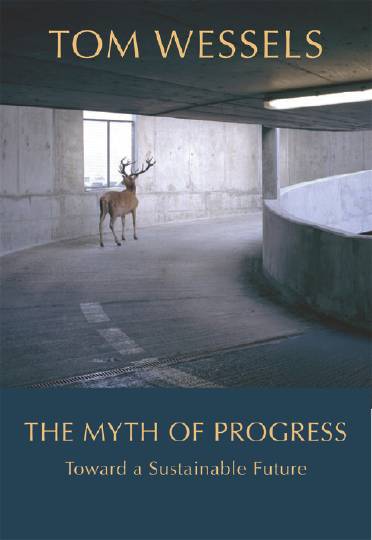
Below is a short overview of “The Myth of Progress: Toward a sustainable future” book by another brilliant systems thinker and ecologist Tom Wessels. The book encompasses the systems science perspective which is a great shortage in academic and non-academic circles.
A provocative critique of Western progress from a scientific perspective. In this compelling and cogently argued book, Tom Wessels demonstrates how our current path toward progress, based on continual economic expansion and inefficient use of resources, runs absolutely contrary to three foundational scientific laws that govern all complex natural systems. It is a myth, he contends, that progress depends on a growing economy. Wessels explains his theory with his three Laws of Sustainability: (1) the law of limits to growth, (2) the second law of thermodynamics, which exposes the dangers of increased energy consumption, and (3) the law of self-organization, which results in the marvelous diversity of such highly evolved systems as the human body and complex ecosystems. These laws, scientifically proven to sustain life in its myriad forms, have been cast aside since the eighteenth century, first by western economists, political pragmatists, and governments attracted by the idea of unlimited growth, and more recently by a global economy dominated by large corporations, in which consolidation and oversimplification create large-scale inefficiencies in material and energy usage. Wessels makes scientific theory readily accessible by offering examples of how the Laws of Sustainability function in the complex systems we can observe in the natural world around us. He shows how systems such as forests can be templates for developing sustainable economic practices that will allow true progress. Demonstrating that all environmental problems have their source in the Myth of Progress’s disregard for the Laws of Sustainability, he concludes with an impassioned argument for cultural change.
CHAPTERS
THE MYTH OF CONTROL: COMPLEX VS LINEAR SYSTEMS
Our culture is pretty much immersed in the linear paradigm which has been powerful but very limited when you’re dealing with complex systems. One of the postulates of such thinking is ‘it worked in the past so it will continue working in the present’ which completely ignores feedback loops. Everything that we deal with, except machines, are complex systems. In linear systems, there’s a sense that if you know the parts, you know the system then you can control it. That’s why a lot of our interventions in things like foreign policy and others are misguided; we try to fix particular little things without understanding the system. So that is the myth of control. In complex systems, however, we can’t control things; there are feedback loops, there are bifurcation events, things we can’t anticipate. We can end up having more havoc or problems by not understanding that. What we need to do is to see systems in a much larger holistic way and see if there’re points of intervention we can work with instead of tweaking with parts and/or changing them. What’s needed is looking at and dealing with the whole dynamics.
THE MYTH OF GROWTH: LIMITS AND SUSTAINABILITY
We don’t have any examples of systems that continuously grow; all systems are nested within other systems. So like our cells are nested within our bodies; we’re nested within the biosphere. Because of that nestedness if anyone in the system keeps growing it’s going to start degrading the larger system it’s within. You’ll get a feedback loop from that larger system that will eventually curtail that growth. So the notion we can only progress through economic growth it’s misguided especially the growth which is based on every increasing use of energy and material resources. All we do is degrading the biosphere to a greater and greater degree and then the feedback eventually kicks in and just stops that growth.
THE MYTH OF ENERGY: THE SECOND LAW OF THERMODYNAMICS
I focus on the third state in my book; when a system is bleeding off more energy from its transformations than it’s taking in. That’s a state when a system becomes entropic. It moves from a state of complexity to a state of simplicity, from a state of concentration of energy and materials to a state of diffusion. Around 300 million years ago the biosphere became a mature system; it was at dynamic equilibrium but for the first time in its history it’s an entropic system now. And it’s solely because of our actions where we’re transforming such high rates of energy that we’re surpassing the amount of energy coming in and being fixed within the biosphere. So the biosphere becomes simplified; energy and materials are being diffused.
THE MYTH OF FREE MARKET: THE LOSS OF DIVERSITY AND DEMOCRACY
As self-organizing systems are developing they are getting more complex. The complexities derive from the parts becoming ever more specialized but tightly integrated as a result self-organizing system grows increasingly resilient and stable. Coevolution is a self-organizing process and through time it’s creating species that are becoming more and more specialized which means that an ecosystem can support more and more species through time and build up a lot of repetition of function and functional critical roles. So self-organization decentralizes critical functional roles. Whenever we move in the opposite way of concentrating or centralizing critical roles, the system moves towards instability and lack of resiliency. And that’s what pretty much our market system has done.
THE MYTH OF PROGRESS: A NEED FOR CULTURAL CHANGE
It’s about the loss of the relationship. In our culture, thanks to technological advancements that have been created at the expense of nature’s exploitation, we’ve become physically comfortable but experientially and relationally poor. Technology is a useful tool and we can use it appropriately but we have to be very wise about our technologies. Thinking that we can continuously progress and technology can solve all our problems is crazy because all the problems we are facing are the result of technologies. The problems have to be solved by us behaving in a totally different way.
Written by Irina Le
 Earthetics
Towards a sustainable future is ideal to read. Thank you 😊
LikeLiked by 1 person
Thank you for reading! ❤️
LikeLiked by 2 people
You are welcome 😊
LikeLiked by 1 person
Excellent. Engineers understand systems, but too often (like economists) enclose their “problem” with boundaries. Everything outside the boundary is just an “externality”. I must read Tom’s book!
LikeLike
Thank you for your comment, David! I’m glad that the article motivated you to read this wonderful book! Best.
LikeLike