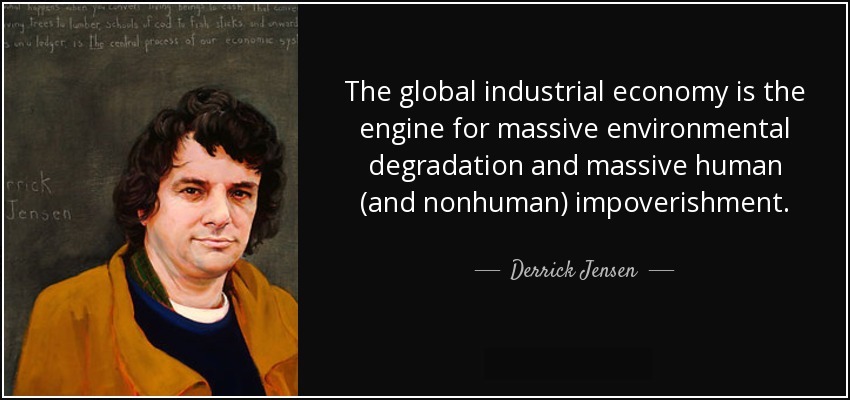
I’m delighted to know Derrick Jensen and his work. I encourage my readers to read more of it. He asks crucial questions that everyone should ask if we want to survive as a species. Another question is do we really care to survive? Too few people are doubting the dominant culture and too many are taking it for granted without any actions against it. As Stan Rushworth noted: “It’s not human beings that have made things colossally dire; it’s a particular type of thinking, it’s a predatory type of thinking. Jack Forbes calls it ‘the wetiko’ which means ‘cannibal’. This predatory psychology is completely justified as the natural state of man. And that’s where the guilt comes from because it’s not true and everybody knows in the deepest part of their heart that we’re way better than that.”
Throughout the history of humankind, resources have been concentrated in the hands of few. When resources got depleted, civilizations collapsed. Well, it wasn’t that bad because they were local. Now, technology allowed for globalization and thus much faster depletion of the planetary resources. The principle of the system hasn’t changed except for the scale; it’s global now. We live in the times of witnessing a global civilization collapse; it’s starting to crack down.
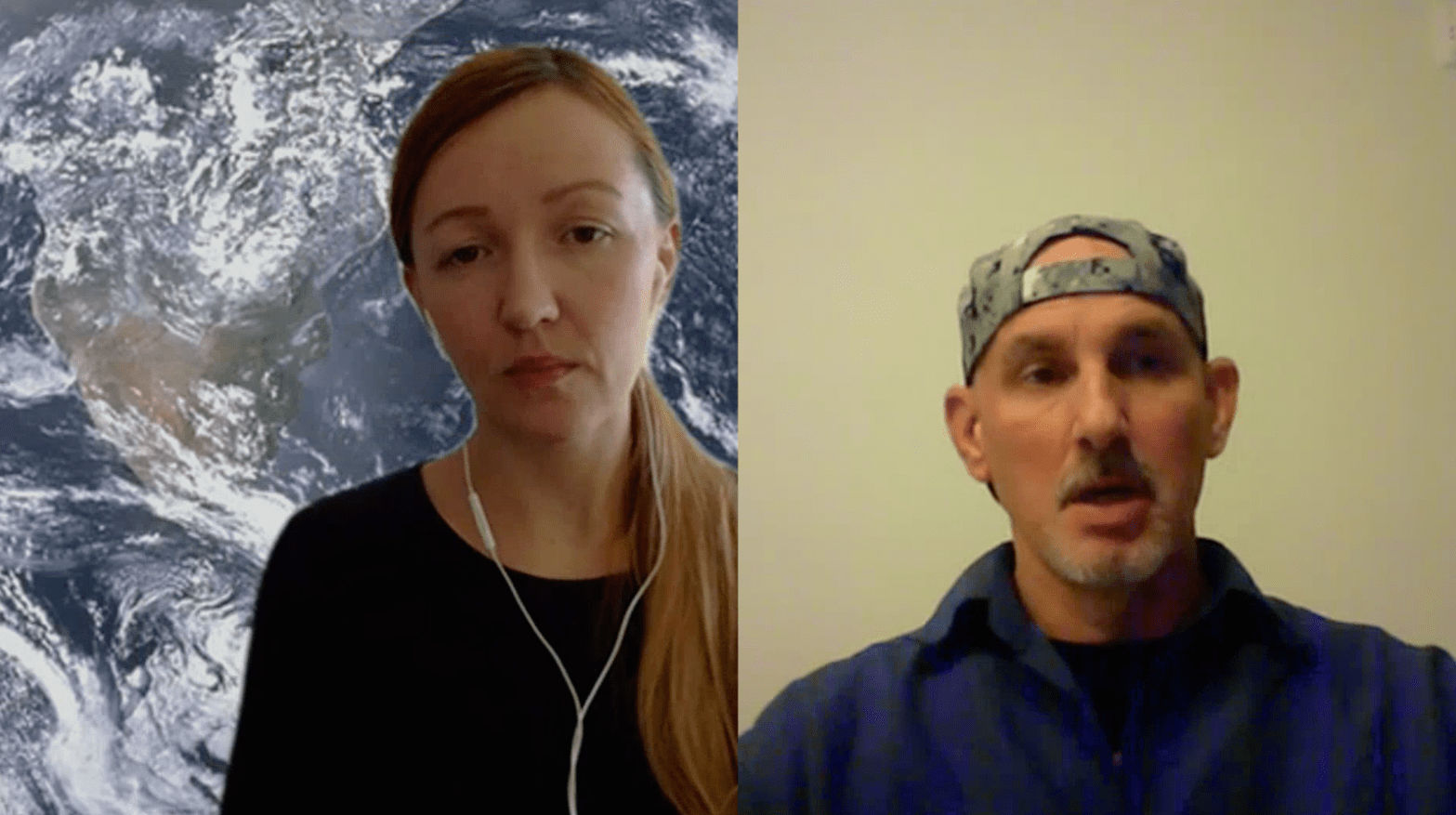
I had the pleasure of having a conversation with Martin and we touched upon the following points:
1. Popular Myths.
2. What Are Some Causes of Dysfunctional Worldviews.
3. Challenges in Creating Global Collaborative Efforts.
Martin is perhaps, presently, the only Ecocentric-Humanist, and a Culture-Repairer, who makes use of Metapsychology – defined here as the process of elevating awareness about the ways by which we think – and applies his theory of “Homo-sapien-Domestication” (HsD) – A Human Domestication Syndrome – to the science of Sociocybernetics, for philanthropic-purposes.
Please note that when I, or others, use the term “Homo sapiens,” while Martin uses the term the “Homo communia,” that we are both speaking of the ONLY species in the “Homo” genus currently alive today – our own species. We are both speaking of the billions of “people-primates” who wear clothes on this planet. This was not a conversation meant to prove that “Homo sapiens” do not really exist as defined by this term.
I tried to invoke the religious types of fervor that most people have for believing in technology as a cure to everything that we are doing wrong – and seek to remain in denial about. Martin agrees with me that even among the non-religious, that this can be defined as a CULT that believes in the unfounded endless-possibilities of technology as a cure to everything – while also avoiding the most meaningful conversations about what the real issues are – a lack of “human-thinking-tools” and an ongoing lack of acknowledgment that our species possesses far less types of intelligence (balance) that would be of better benefit to us if choosing to continue to belong to our living-globe. When I speak of the 3% critical-mass (in social-terms), I’m referring to: https://en.wikipedia.org/wiki/Critical_mass_(sociodynamics)#:~:text=In%20social%20dynamics%2C%20critical%20mass,sustaining%20and%20creates%20further%20growth. And also to: https://www.youtube.com/watch?v=u3LtIu2s8bI We would also like to bring your attention to a different definition of “collective-Learning” and its various offshoots: https://en.wikipedia.org/wiki/Collective_wisdom
Still, Martin believes that the concept of critical mass, or of paradigm-shifts, are no longer reliable models because of “HsD” – The people-primates and their species-wide ailment of Human Domestication Syndromes (debilitating mental-illnesses that affect majorities). We are not acting like social-creatures that can be measured by sociodynamics any longer, and this is not a good thing, as we can not longer make use of the social sciences for future planning unless we understood “HsD,” Sociocybernetics, Humanics and Cultural-Repair principles more fully. This is why Martin insists on first seeking to address our cognitive-programming’s failings, because being able to rely on such mathematical-science again would be imperative. I could study another activist-movement from the inside, as a participant to better compare and learn further from the Extinction Rebellion, The Venus Project, and this third social-structure.
Finally, about Earth-like planets. If no life at all exists there, the task of generating it would require God-like abilities, something that our “human-chauvinism” falsely allows us to believe that we are capable of possessing – while still being observed as being less “wise” than insect-colonies, Orangutans and Dolphins. And if there are some variations of life on those other planets, we would like to point-out how the Martians were defeated when they tried to invade Earth in the science-fiction movie that was more recently produced and that starred Tom Cruise. Tom made a great hero in that film, but still, he had nothing to do with the defeat of the Martians as an invading life-form/invasive-species.
If the majority of people had multidisciplinary knowledge and systems thinking we’d be way beyond where we are now. We’d allow science and technology to be used for our common societal benefits, not for the profits of the industrial tops.
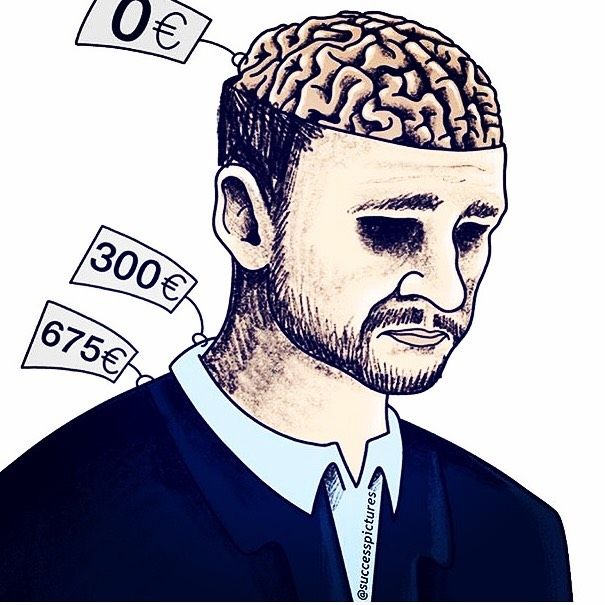
One could argue that In our monetary-based society the vast majority is busy with surviving by doing jobs they hate so the last thing they care about is learning about what matters in the world. Even the corporate rich folks, as Yuval fairly pointed out, are too busy to learn how to see the big picture.
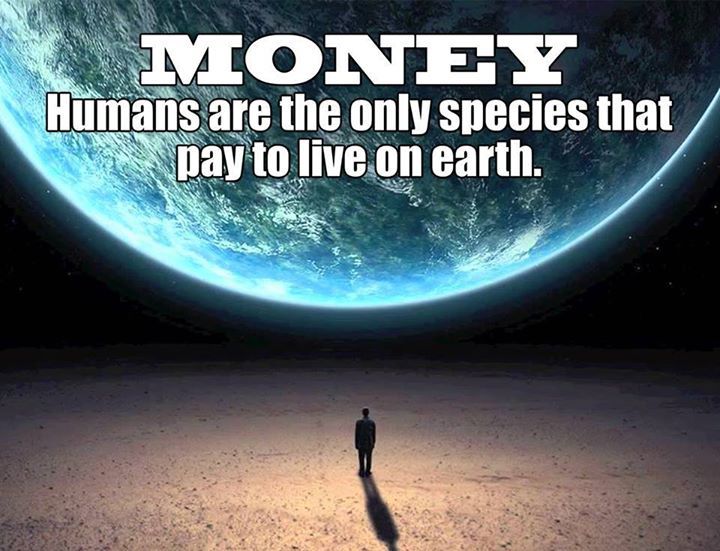
Though not many realize that breaking up with money is incredibly hard systematically. Money is an idea that unites everyone as everyone believes in its existence despite your our age, nationality, religion or political affiliation. If tomorrow everyone stopped believing in money, it will be gone but then there would chaos as there’s no replacement of such a powerfully uniting idea that everyone believes in. Another powerful side of money is its usefulness as a tool. Humans have been creating and using tools for millions of years; our tools have changed a lot over that time but our brains have not changed much; physiologically, we have the same brain that our ancestors, hunters and gatherers had, now using digital devices instead of spears to get our food.
Yuval Noah Harari: Panel Discussion on Technology and the Future of Democracy:
There has been plenty of research and articles on how kids or impoverished are enslaved for the profits of global corporations and the enrichment of the wealthy to feed the industrial civilization. There has been also a good look into how employers exploit their employees by diminishing their value to a single economic activity and to a unit of cheapest labor. A good number of articles have talked about how much we’re addicted to shopping and items that we throw away or stop using when they bore us. However, there has been little exploration into how the values of our ‘fast food society’ are intervened in the relationship with our family, friends, or any other human being.
Let us first define what a ‘fast food society’ is. In today’s era of technological advancements, people want to get results right away as the environment of convenience and instant transactions reinforce such expectations. Just like you get fast food ordered online, finger paid using your phone, and delivered to your home in a matter of minutes. The same goes for the convenience of ALL INCLUDED vacation packages so you don’t really need to do any extra work before you travel, you just pay.
Social media is probably the most profound example of how our ‘fast food values’ are reinforced without us realizing that. As you scroll down, you get immediate results of who or what you’re interested in. Even though the results are getting farther and farther from your interest match, your brain can’t figure it out; as long as it can build associations it will keep up with the addiction. On social media, you get the information immediately by tapping your finger and if the video or photo doesn’t load for a few seconds, you may try a couple of times more and give up on it, sounds familiar? Now, let’s entertain our brain and imagine that video or photo is actually a human being. It’s not easy to imagine so, is it? Let me draw the link in between to ease the challenge.
From our day-to-day interactions with our boss, supervisors, or managers, we realize that they are less or more likely to be satisfied with our work mainly depending on the two conditions: our work is done well and it’s done on time. It’s mostly because your boss, supervisor, or manager needs to extract economic value from you to make a quick profit for the company or institution you’re working for. And so for any kind of job, not only the quality but also a deadline or speed is essential.
What if you volunteer to help your family, friends, or community who are themselves involved in helping others without the time pressure? Ah, sounds so sweet, doesn’t it? You think, there aren’t any monetary values involved, there’s no deadline, no standards for your work’s quality as reassured with the community you offered your help to. After you spend half of your day on the project, you present it as a tool that could help the community grow bigger. However, you run into a technical problem that needs a few minutes to get resolved which means your work isn’t accessible immediately. Remember the example with the video or photo which won’t load instantly? In a ‘fast food’ society, if you don’t provide a thing right away, you don’t meet people’s expectations thus your work’s value is quickly eroded. If your work has a low value, you, as a person, have a little value even if your previous commitment was appreciated by the community. Moreover, people tend to remember negative events more than positive ones. So you realize that you have missed the point that ‘fast food society’ values the speed above the quality. You fall behind ‘fast food values’ as you are still the one who would wait until a video of a higher resolution containing hours of somebody’s voluntary work and passion uploads or downloads.
You also fall behind the dominant social paradigm, as you are still the one who would ask the committed person for further help to change the video to meet the needs (speed is above quality) of your community. The latter has more to do with the degradation of human to human communication such as the ability to express your needs. Yes, you’ve read it correctly: ‘the ability to express your needs’; nowadays we have to learn how to express our needs. Though, it’s the next discussion.
P.S. In this piece, I don’t intend to diminish the value of technology or social media to the convenience of our social interactions. I’m using a laptop to write this article which wouldn’t probably be reaching you without its existence. What I’m trying to do with the real-life situations described above is having you to think of ‘fast food values’ invasion into our most genuine human interactions: friends, family, communities, etc.
In this episode physicist, Ian Hutchinson extrapolates on why “People NOT Dying Is Ultimately More of a Problem Than People Dying”. He brings up the numbers why there’re no techno fixes and what the real challenge is.
“The reason why we are not talking about population, consumption, and the suicide of economic growth is that it would be bad for business, especially for the cancerous form of capitalism that rules the world”. ~ Jeff Gibbs
Until we learn how to function in ecosystems by prioritizing those above our current egosystems we may not make a leap in the awareness needed for our species to survive.
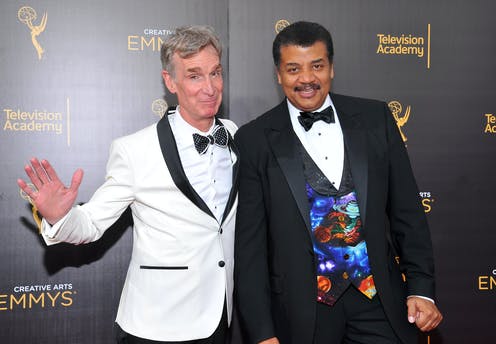
First of all, I’d like to mention as a science educator myself that these two guys are great in educating the public about science and scientific thinking. Below is the criticism that I don’t think they will read but I hope someone else will take time to consider as anyone who claims to possess critical thinking skills must question everything they know because only then they have the potential to change and grow their mind.
If I were in a conversation with Nye and Tyson; I’d crack down their arguments in a minute. Note, I’m not even a scientist but I’m a systems thinker and it seems to me that systems thinking is what these two great guys are missing. We all miss something because we’re humans, beings who are full of cognitive biases and dissonances. Tyson and Nye tend to insert their values into the arguments they present and everyone who has similar values applauds them. Well, probably, they have to do so on purpose so their audience will stick to them. But then there’s a danger of blindness of taking the words of popular figures like Tyson and Nye for granted.
Bill Nye Interviews Dr Neil Degrasse Tyson — COSMOS Possible Worlds:
So our conversation would go this way.
Tyson: Vegetarians eat plants that just started to reproduce but get killed and eaten by them, those who oppose killing a life.
Me: It seems to me you miss the fact (and so you tend to make this generalization) that is according to the recent surveys, most people who go vegetarian or vegan do so for health reasons or to reduce their impact on the environment, not because they don’t want to kill a life.
Nye: Thank you all for coming. I appreciate all for coming out tonight. Please take precautions.
Me: You’ve gathered an audience in a closed space during the global pandemic, in the country which is hardest hit by the pandemic to talk about scientific literacy and ask the audience to take precautions?
Nye: We’re competing with something that thinks nothing about taking anyone of us out.
Me: What can a virus think? A virus doesn’t think, nor it distinguishes species on which it feeds to survive by gradually killing the host and eventually itself. We’re very arrogant to think that it should consider us; it’s purely a projection of human beliefs into what we believe should happen. The objective reality doesn’t care about your expectations, values, or beliefs.
Moreover, we’re not competing with it, nor ‘it’s our enemy that won’t negotiate with us’ as Tyson says further. Viruses have been on this planet much longer than our species. It’s like saying: ‘we’re competing with nature’, which is an absolutely retarded notion even for own survival. That belief is exactly what got us into the current mess known as the 6th mass extinction: “Humans are the master of other species for the progress and prosperity of their own species”. The objective reality is that as we kill species and invade the habitats of other species, we won’t survive without those as they constitute the basis of life on this planet, ‘the only home we’ve ever known’ (Carl Sagan). So ask yourself who is the bigger virus by behavioral dynamics?
Nye: We’ll get through this because we will all wash our hands.
Me: You seem to lack knowledge of how respiratory viruses are passed on. Respiratory viruses are not only passed through surfaces; they are more quickly passed through air droplets, and people knew that since the Spanish flu and even earlier. It’s part of basic scientific knowledge that an average person at least here, in Taiwan, has but scientists and educators don’t have it? No wonder, why the US folks refuse wearing masks. Why should they if even their scientists and educators don’t do so?
Nye: For most people in the world things are less messed up than ever. There are fewer people in extreme poverty. If you are even born in the poorest part of Africa, there’s a chance that your kids will do better than you do which is everybody’s dream.
Me: First, all that progress for humans has come at the tremendous cost of nature exploitation and its destruction that you prefer not to mention as you, as a human being focuses on your own species’ progress and prosperity. It’s a perpetuation of the same way of thinking and values I mentioned earlier: “Humans are the master of other species for the progress and prosperity of their own species” which is the most dangerous belief of our times. Secondly, if things are less messed up for people now it doesn’t mean there is such a trend; and that is where you’re wrong regarding kids having a better future in the poorest part of Africa. By all indicators that sustain our life on this planet, we are more and more messed up than ever: overdevelopment, overpopulation, ecological overshoot, species extinction, resource depletion, water and soil contamination, climate disruption, etc. Politically, the world is shifting towards dictatorships.
I’m quite stunned that those basics are not even mentioned. Though, I’m actually not that stunned when I take into consideration how much of the human value system is engaged in this talk. You wouldn’t have such a big audience if your talk was named ‘Civilization collapse’. I can assure you, as I’ve done it myself. People don’t pay money for despair if even it is acquired along with the crucial knowledge that the majority lacks. They pay for entertainment or optimism or hope that you and Tyson are so obviously indulged into. So the monetary motive redirects your audience’s attention and interest.
Nye: Humankind now is running the show; we probably didn’t intend to but now we’re in charge and thinking about other words and going there is just human nature to imagine that.
Me: No, humankind isn’t running the show anymore. That is what you want to believe is happening until you learn about the exponential function, systems dynamics, collapse of civilizations, the Jevons paradox, limits to growth, climate disruption, ecosystem collapse, and coextinctions.
Tyson: We’re imagining the future where we have active CO2 atmospheric scrubbers.
Tyson: We shouldn’t demonize the consumption of energy; you demonize the consequences of consuming some kinds of energy relative to others.
Me: You didn’t seem to do your homework on technological fixes of our broken culture. Once you unlearn the dangerous notion of techno-fixes/solutions to our human predicament by studying more on the topics mentioned above, you may or may not divorce the dangerous belief you’re advocating for.
As an example, let me extrapolate a bit on the Jevons paradox. You have to realize that Moore’s law doesn’t apply to energy. When we deal with energy, we deal with physics. Unless you can find a way around physics, any consumption of energy is going to be powered in some way. The more we become energy efficient, the more energy we consume, that’s is the Jevons paradox I though physicists were aware of. So far, no amount of technology and no amount of human ingenuity can possibly overturn the laws of physics, the laws which govern this planet.
Nye: Talk about climate change and vote.
Me: So you got me to start on politics. You ask people to vote to elect a billionaire to appoint other billionaires to fix the system that made them billionaires? In a nutshell, the US is run by one party which is the business party with two fractions which in essence carry out variations on the same policies which are opposed by most of the population. Take the New Green Deal, for example, it’s just as flawed as previous fossil fuel deals or whatever they were called in the past. The Green New Deal is a perpetuation of the industrial civilization to continue with nature exploitation and destruction for the progress of humankind and capitalism (or any other kind of profit-oriented monetary system). It doesn’t talk about degrowth and/or depopulation; neither talks about the system’s change. All it talks about is patchwork as known as a switch to another type of energy extraction. Well, another type of energy extraction known as renewables requires enormous quantities of minerals by digging the sea bed, forest depletion, vast land and it still plugged into a fossil fuel grid to satisfy the current level of energy demand. The Jevons paradox, mentioned above, is an additional beast showing how little sense the Green New Deal makes. Politicians are completely uneducated on how to manage societies and you call people to vote for them? I’d love to be wrong about that; name a politician advocating degrowth policies, shutting down most of the industries and re-educating everyone to restore the environment they have loused up. This is based on the objective reality that needs to be done globally if we want to save the rest of the species our life depends on.
Those are just some of the arguments I’d deal with along with asking a thousand questions that might or might not make them question their own values that they seem to insert into the objective reality of our world. There’s no perfection, only the improvement.
 Earthetics